

If you retired expecting to feel lighter but instead feel foggy, flat, or mentally exhausted—even after a full night’s sleep —this will make sense in about 90 seconds.
Here’s what happened: For 30 or 40 years, your job gave your brain a hidden workout. When that stopped, your brain lost its daily exercise and started to weaken. For many people, that feels like fog.
The good news: You can rebuild it. A 2023 study at University College London found that retirees who reintroduced three specific types of mental activity saw cognitive improvement within 4-6 weeks. Not stress. Not overwork. Just targeted mental exercise.
By the end of this article, you’ll have:
- One activity chosen for this week
- A clear starting point (even if you’re tired right now)
- A 7-day plan you can actually stick to
If you’re foggy right now: Skip to “The 10-Minute Start” at the bottom, do that first, then come back.
What You Actually Lost (The Real Reason for the Fog)
Let me show you with two Tuesdays:
Tuesday at 58 (still working):
- 7:30 am: Get ready while mentally rehearsing a meeting
- 9:00 am: Meeting—you defend a decision, think on your feet
- 10:30 am: Problem surfaces—you spend an hour working out solutions
- 12:00 pm: Lunch with a colleague, debating the new system
- 2:00 pm: Focused work on something challenging
- 4:00 pm: Quick decision: approve or send back?
- 5:30 pm: Drive home, processing the day
Tuesday at 62 (six months retired):
- 8:00 am: Wake with no particular plans
- 9:00 am: Read the paper—same sections as yesterday
- 10:30 am: Tidy up (again)
- 12:00 pm: Lunch
- 1:00 pm: Television
- 3:00 pm: Quick shop for milk
- 4:30 pm: Try to read a book, but realise you’ve read the same page three times
- 6:00 pm: Feel inexplicably tired despite doing very little
See the difference? The first day had novel problems, decisions under pressure, and complex conversations. Your brain had to work.
The second day had almost none of that. When your brain is no longer regularly challenged, the neural pathways that support focus, memory, and clear thinking weaken, like a path through the woods that disappears when no one walks it.
For many people, that feels like:
- Sitting down to do something and forgetting what it was
- Can’t “get your brain into gear”
- Conversations feel like an effort
- Reading the same thing twice to understand it
- Tired but restless at the same time
This isn’t cognitive decline. It’s cognitive underuse. And research shows it’s reversible.
Quick Medical Note (Brief but Important)
Brain fog can also come from sleep problems, low mood, medication side effects, thyroid issues, or vitamin deficiencies.
See your GP if:
- Fog appeared suddenly or is worsening noticeably
- You’re getting confused or lost in familiar places
- Memory changes worry you or your family
- You feel low most days or anxious in a new way
- It’s affecting daily tasks (bills, cooking, safety)
That’s sensible maintenance, not overreacting. Get it checked, then come back to this.
Still here? Good. Let’s fix the underuse problem.
What Actually Works (Backed by Research + Real Examples)
A 2023 UCL study tracked 240 retirees who felt “mentally foggy.” They tested different interventions. Three things produced measurable improvement within 4-6 weeks:
- Learning something genuinely new (not harder crosswords—actual new skills)
- Conversations with novelty and depth (not more chat—different chat)
- Projects with finish lines (not hobbies—things you complete)
Retirees who did all three saw the biggest improvement. But even one helps.
Here’s what that looked like for real people:
Jean, 66, retired office manager (March 2024):
- Tried Spanish (too much like school—quit week 2)
- Switched to watercolour class (felt clumsy but stuck with it)
- Week 4: Noticed she wasn’t re-reading news articles
- Week 8: Could focus on novels again
- Week 12: Finished a small garden project, felt “like myself”
David, 63, retired electrician (July 2024):
- Joined a book club (first time discussing books since school)
- Started a 90-day project: organise and print 20 years of photos
- Week 3: “A bit early to say”
- Week 6: “My wife says I’m sharper—less repeating myself”
- Week 10: Fog mostly gone, energy noticeably better
What didn’t work: More of what they already did. David tried harder Sudoku puzzles first—made no difference. Jean tried walking more—good for fitness, didn’t touch the fog.
The key: New pathways, not stronger existing ones.

Part 1: Pick One New Skill (That Makes You Feel Slightly Clumsy)
Most retired people do “maintenance activities”, the same crossword, the same book genre, the same gardening routine. They’re enjoyable but don’t challenge the brain because you’re already good at them.
You need something new enough that you think: “Right… I’m not good at this yet.”
That mild frustration signals you’re creating new neural pathways. Work forced you into this regularly (new software, new procedures). Retirement doesn’t.
How to choose (if you’re overthinking it):
The research doesn’t say you need a specific skill type. It says you need novelty, challenge, and repetition. So:
- Pick something you’ve been curious about but never tried
- Make sure beginners are welcome
- Check you can practice 2-3 times a week
Real examples that worked:
- Former teacher → pottery (not language—too similar to work)
- Former engineer → creative writing group (needed less structure, more interpretation)
- Former nurse → digital photo editing (new but related to existing interest)
- Former accountant → community choir (opposite of solo analytical work)
If you’re stuck: Ask yourself: “What have I avoided because I thought I’d be bad at it?” Start there.
Your weekly commitment:
- 3 sessions per week
- 30-45 minutes each
- Phone is silent, no multitasking
- Stop while you still have energy (so you’ll return)
Low energy version: 15 minutes, twice a week. Showing up matters more than duration.
Where to find it:
- Google: “[your town] + U3A” (University of the Third Age—huge range of groups)
- Library noticeboards
- Local Age UK
- Meetup.com
- Online: FutureLearn, OpenLearn, YouTube beginner courses
First action: Look up three options today. Pick one. Contact them tomorrow.
Part 2: Upgrade One Conversation Each Week
At work, you had built-in debate, disagreement, and problem-solving. That kind of talk requires mental effort; it’s cognitively active.
If every retirement conversation covers the same loop (weather, aches, hospital news, same stories), your brain can drift to autopilot. Nothing wrong with those chats, but you need at least one weekly conversation with more novelty.
Why this matters: A 2022 study at King’s College London found that regular “cognitively demanding conversation”, discussion that requires thinking, not just recounting, improved memory and mental flexibility in over-60s by 19% over 12 weeks.
Three ways to get it:
Option A: Join one topic-based group: Book club, history group, current affairs discussion, photography club, U3A group, or volunteering with planning meetings.
One session every 1-2 weeks is enough.
Option B: Add one “depth question” to regular meet-ups
Next time you meet a friend, after the usual catch-up, try:
- “What’s something you’ve changed your mind about recently?”
- “What are you learning at the moment?”
- “What’s the most interesting thing you’ve read this week, and why?”
Real example (from Jean, above):
Her friend Ann begins discussing her hip replacement. Jean listens properly, then:
Jean: “That sounds really difficult. Hope it settles soon. Hey, completely different topic—I read something about robots being used in surgery now. Did you see any of that when you were in?”
If Ann engages: The conversation shifts to something novel. Both brains wake up.
If she doesn’t: “Fair enough, probably the last thing you want to think about! How’s your garden coming?”
The goal isn’t to force depth, it’s to offer it once and follow their lead.
Option C: Shared input meet-up
Pick a short article, podcast, or documentary. Both consume it before meeting. Discuss over tea.
Example: “There’s a 20-minute podcast about local history. Fancy listening and meeting for coffee to talk about it?”
This replicates the work structure: “We both reviewed the material, now let’s discuss.”
Low energy version: One phone call per week with one prepared question.
Part 3: Pick One 90-Day Project (The Fog-Lifter for Most People)
This is where the UCL study saw the biggest impact.
Projects beat hobbies for lifting fog because projects have structure: deadlines, outcomes, progress markers. Work organised your brain this way automatically. Retirement doesn’t.
A project gives your brain:
- Something to plan (weekly steps)
- Reasons to focus (working toward something)
- Momentum (visible progress)
- A finish line (completion, not endless maintenance)
Why 90 days? Long enough for momentum, short enough for urgency. Work did this automatically with quarterly cycles.
Good projects (specific outcome + finish date):
- Family history booklet (20 pages, printed, given to grandchildren by June 1st)
- Transform one garden section by the end of May (specific plants, layout, before/after photos)
- Learn 12 new recipes, create a printed “favourites” book by August
- Organise and print one photo album covering 2010-2020 (actual physical album)
- Start a monthly walking group and run six walks (recruit five people, plan routes)
Poor projects (too vague):
- “Do more gardening”
- “Learn to cook better”
- “Organise photos”
Your 90-day plan:
Week 1:
- Choose project
- Write a specific outcome
- List 5-8 major steps
- Set finish date (in calendar)
Weeks 2-11:
- Two work blocks per week (30-90 minutes)
- Tuesday and Friday mornings work for many—pick what suits you
Week 12:
- Finish and share (or just mark “completed”)
Example: Family History Booklet
- Week 1: Format (20 pages), gather photos, list stories
- Weeks 2-4: Interview family, record stories
- Weeks 5-8: Write draft, organise photos
- Weeks 9-11: Edit, format, choose printer
- Week 12: Print five copies, give to grandchildren
Low energy version: 30-day project instead. Example: “Cook and photograph six new meals, create a simple favourites folder.”
The 10-Minute Start (Do This Now)
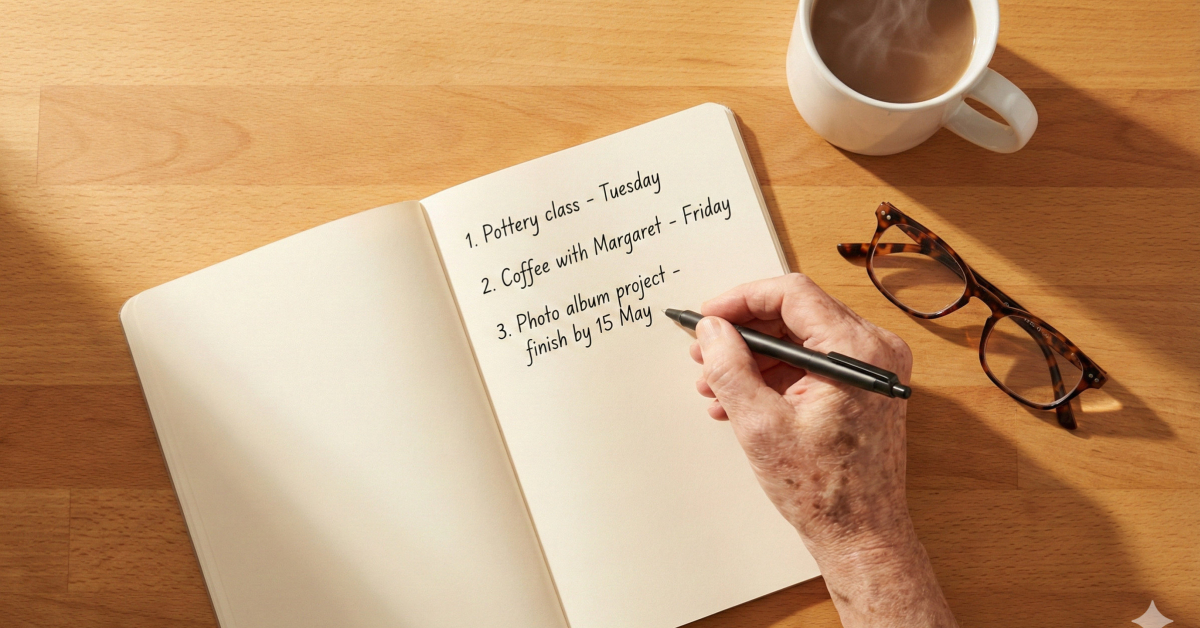
Before you close this page:
- Write down one new skill you’ll try (even if you don’t know where to find it yet)
- Text or call one person to arrange a meet-up (coffee, walk, or phone call)
- Choose one project and write the finish date
Three lines on paper. That’s your start.
Tomorrow: Take one action on any line. Just one.
Your 7-Day Plan
Day 1: Pick your skill + find one local or online option Day 2: Arrange one meet-up or choose one depth question for next chat Day 3: Choose your project + write outcome + deadline Day 4: First 30-minute skill session Day 5: First 30-minute project block Day 6: Rest (this matters) Day 7: Second skill session OR second project block
The Restart Rule: Miss a day? Just restart the next day. No catching up, no guilt.
If You Only Have Energy for One Thing
Start with the project.
The UCL study found that projects led to the fastest improvement because they create daily structure and momentum. That structure often reduces fog more quickly than skills or conversation alone.
Once you feel clearer (usually 3-4 weeks), add a skill. Then upgrade conversations.
Troubleshooting: “I’ve Tried This for 4 Weeks and Still Feel Foggy”
Check these:
- Is your skill actually challenging? Comfortable from day one = maintenance, not stretching. Pick something harder.
- Are you doing it consistently? Three times weekly beats one intense weekend. Brains strengthen with regular practice, not cramming.
- Are you sleeping properly? Waking at 3 am regularly? No mental exercise will clear the fog. See your GP about sleep specifically.
- Is low mood the real issue? Feeling flat, hopeless, or uninterested most days? That’s different from cognitive fog. See your GP about your mood; very effective treatments are available.
- Are you socially isolated? Only seeing people once a fortnight or less? Loneliness creates fog. Prioritise the conversation upgrade.
Common Obstacles (Real Solutions)
“There are no groups near me”
- U3A has online groups
- FutureLearn has free courses with forums
- Start your own: “Monthly coffee morning for [topic discussion]”—advertise at library, post office, church
“My partner doesn’t want our routine to change”
- Don’t change shared time
- Add activities during their solo time (their hobby time, their TV program)
- Frame it: “Trying something to help with this fogginess I’ve been feeling”
“I tried learning once and hated it”
- You probably picked wrong
- Try three different things (two weeks each) before deciding
- Ask: “What have I always avoided because I thought I’d be bad at it?”
“Too tired to commit to regular activities”
- Start with low-energy versions (15 minutes, twice weekly)
- Do it first thing when energy is highest
- See GP about the fatigue itself—may have a treatable cause
“Don’t want to meet new people”
- Upgrade existing relationships with depth questions
- Solo projects still work (photo album, family history, garden)
Some online courses have no social component.
When to See Your GP
This works for cognitive underuse. It won’t fix medical issues.
See your GP if:
- Confusion, getting lost in familiar places, sudden memory changes
- Low mood most days, panic attacks, persistent anxiety
- Severe ongoing sleep problems
- Fog appeared suddenly, worsening noticeably, or affecting daily tasks (money management, cooking safely, finding the way home)
Support isn’t weakness—it’s maintenance. Brain fog that won’t shift deserves proper attention.
Final Word: What You’ll Do in the Next 24 Hours
The research is clear: retirees who reintroduced challenge, complex conversation, and structured projects saw measurable cognitive improvement within 4-6 weeks.
You don’t need all three immediately. Start with one:
If you have low energy: Pick the project. Structure creates momentum, and momentum reduces fog.
If you’re socially isolated: Upgrade conversations first. Join one group or add depth questions to existing chats.
If you’re bored more than tired: Start the new skill. Novelty wakes the brain faster than anything.
Most people notice: Sharper thinking week 3-4. Fog significantly lifted by week 8-12.
Your next 24 hours:
- Google one thing (class, group, project resource)
- Contact one person (to meet or join)
- Write three lines (skill, project, date)
The path through the woods grows back when you start walking it again.
Start walking.
Resources:
- U3A: u3a.org.uk
- Age UK: ageuk.org.uk
- FutureLearn: futurelearn.com
- OpenLearn: open.edu/openlearn
mental fog after retirement, brain fog over 60, cognitive decline after 60, retirement brain health,
mental fatigue in seniors, post-retirement depression, how to stay sharp after 60, retirement, cognitive activities, brain exercises for retirees, mental clarity after retirement.
Join people over 60 in Marketing with Martin, my new private Facebook group, where you’ll be able to share and discuss:
✓ Which local classes they’ve tried (and honest reviews)
✓ “Week 4 update” progress reports
✓ Project accountability check-ins
✓ Troubleshooting when things aren’t working
✓ Real conversations about brain fog, energy crashes, and what’s actually helping
It’s not a cheerleading group. It’s practical support from people doing the same thing you’re starting.


