

You’ve seen the ads. You’re sceptical. So let’s skip the warm-up.
Yes, making money online after 60 really works. Not fast, not passive, and not if you expect results in a month. But if you’re willing to follow clear steps and keep going when it’s quiet: yes, reliably.
Here’s the honest case for why, with no fluff and no shortcuts.
The Distinction That Changes Everything
The biggest lie in online income is that it’s easy. It isn’t. It takes time, effort, and the willingness to learn something new.
But it doesn’t need to be easy. It needs to be simple.
Easy means it happens with minimal effort. Simple means the steps are clear and repeatable, even when the effort is real.
Think of making bread. Difficult the first time, the dough feels wrong, and the timing is a guess. But once you understand the process, it’s simple, the same steps, the same outcome, every time. Online income works exactly like this. Most people quit before simple kicks in.
Why You Have a Real Advantage Here
This isn’t encouragement. There’s a genuine mechanism — and it runs in your favour.
You already have a niche identity. The internet is full of generalists. What it’s short of is people with thirty years of deep, lived experience in one thing. If you spent your career in healthcare, you understand patient recovery in a way no content creator in their twenties ever will. If you were a teacher, you would know how children actually learn to read. If you worked in a trade, you know which tools last and which don’t. That knowledge is the raw material for content that earns. You don’t need to manufacture it; you already have it. On Google, your experience outranks youth every time.
Your scepticism protects you from the most expensive mistakes. The biggest drain on new online earners isn’t time, it’s money spent on overpriced courses and shiny tools that go nowhere. The caution that makes you slow to start is the same quality that will stop you from wasting £300 on a masterclass when a free YouTube video could do the same.
The income you’re probably aiming for is well within reach. If you want £200 to £600 a month, enough to take the pressure off your pension, cover a car, fund a break, that’s not a stretch target. That’s where consistent beginners arrive within 6 to 12 months, across dozens of different topics. You don’t need to build a business empire to get there.
What This Is Actually Going to Look Like for You
Forget influencers. Forget viral videos. Forget competing with 25-year-olds on platforms built for 25-year-olds. Here is what this looks like when it works:
Affiliate marketing: You recommend products you already use, through links that pay a small commission when someone buys. You write a post — “The 5 Garden Tools I Actually Use Every Week” — and when a reader clicks your Amazon link and buys the secateurs you mentioned, you earn between 3% and 8% of the sale. No stock. No shipping. No customer service.
Blogging: You write regularly about something you know well. If you spent your career in healthcare, you write about the conditions and recoveries you understand better than most. If you were a teacher, you would write about the phonics methods and learning approaches you actually used. Google finds your content and sends readers to it — sometimes for years after you wrote it.
Digital products: You create something once, a printable meal planner, a beginner’s guide to watercolour, a medication tracker, and sell it repeatedly on Etsy or Gumroad for £3 to £15 a copy.
Online tutoring: You teach what you know, one-to-one, through platforms like Superprof or Tutor Hunt, at £15 to £40 an hour. If you have a skill, a language, an instrument, a subject, a craft, there is someone who will pay to learn it from you.
If you’re starting with no website and no audience, which is where almost everyone begins, a blog with affiliate links is your simplest entry point. It costs nothing to start, requires the least technical knowledge, and builds steadily over time.
A Case Study: From Zero to £520 a Month
Names and identifying details have been changed, but the numbers and timeline are real, from someone who worked through this process in our community.
Margaret was 64, a retired teacher, with a small vegetable garden in Lancashire and no online experience beyond Facebook and email. Sound familiar?
She started a free WordPress.com blog, the same process as setting up an email account.
Her first three posts:
- “Why Everything I Planted in Year One Died — And What I Grow Now”
- “The 4 Raised Bed Mistakes Beginners Always Make in Cold Climates”
- “My Honest Review of the Haws Watering Can After 6 Years”
She signed up for Amazon Associates (free, twenty minutes) and added links to tools she already owned.
Month 1–3: £0. Google hadn’t found her yet. She kept writing.
Month 3–6: £47, then £83. Margaret noticed her review posts earned more than her advice posts, so she wrote more reviews.
Month 7: £180. Margret was ill for two weeks and missed posts. Income dropped.
Month 9: £340. One post, a comparison of raised bed kits, accounted for most of it.
Month 12: Averaging £520 a month. 38 posts written. 7 of them generate most of the income.
No social media. No advertising spend. No viral moment.
“I genuinely thought I’d left it too late,” she said afterwards. “The first three months, I nearly stopped. I’m glad I didn’t.”
Not everyone reaches £520. Some plateau at £150 and stay there. The difference, almost every time, is whether they stayed focused on one topic or scattered their effort across three.
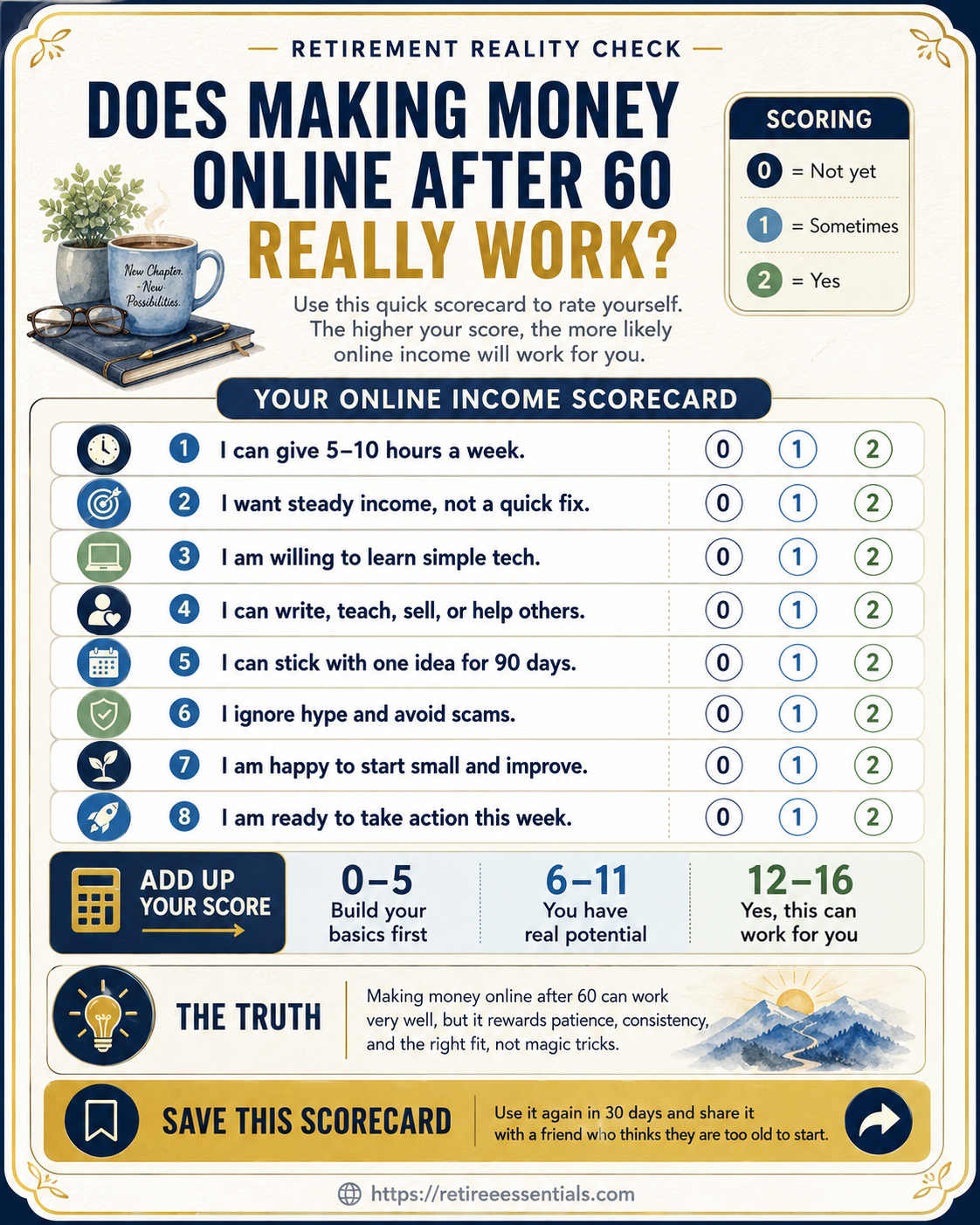
To download your copy of this infographic, simply click download, and a new browser window will open up. DOWNLOAD. There is no sign-up.
Why You Might Not Get There — And How to Make Sure You Do
Most people fail at this for one reason: they stop during the gap.
Here’s what the gap looks like: you’ve set up your blog, you’ve written your first few posts, and almost nothing is coming back. No money. Sometimes, there are no readers at all. Just a quiet blog and a growing question: am I wasting my time?
You’re not. This period, typically three to six months, is normal, predictable, and almost universal. But because nobody explains it clearly at the start, most people read the silence as failure and quit. The ones who don’t quit are the ones who reach month twelve.
The second thing that will tempt you is switching ideas. You start a blog, then hear about dropshipping, then look at selling on eBay, then consider an online course. Each switch resets the clock. Each restart means surviving another gap from zero. Focus isn’t a personality trait; it’s a decision you make and remake every week.
The Minimum You Actually Need to Learn
You don’t need to code. You don’t need a fancy website. You don’t need to understand SEO before you start.
Here is what you actually need, and how long each step takes:
- Set up a free WordPress.com blog: 20 minutes
- Write a 600-word post: 1–2 hours the first time, 45 minutes once you’re used to it
- Sign up for Amazon Associates (UK affiliate programme): 20 minutes
- Copy and paste a product link into a post: 2 minutes
That’s your first month. One post per week. No social media required. No advertising budget.
What Your Income Growth Is Likely to Look Like
- Month 1–3: £0–£25 (mostly nothing while Google indexes your content)
- Month 3–6: £30–£150 (early traction, your first consistent commissions)
- Month 6–12: £150–£600+ (older posts keep earning as new ones build)
This isn’t fast. It won’t pay for dinner in week two. But it is steady, and it compounds. A post you write in January can still earn in September. That is not how a job works.
I’ve worked with people who started their first blog at 62, 67, and 71. The ones who made it past month three were not the most technically confident. They were the most consistent.
What This Does to More Than Your Bank Account
Something changes before the money becomes meaningful.
You have a project. You’re learning something new. You’re building something that didn’t exist before, and other people are finding it useful. Almost everyone in our community who describes month two, still earning almost nothing, uses the same phrase: “I forgot what it felt like to be good at something new.”
The income follows. But that feeling is what gets you through the gap.
Where to Start — Right Now, Today
Before you research platforms or worry about what to write, do one thing:
Take ten minutes and write down three subjects you know more about than most people. Not impressive subjects. Specific ones. They might be: managing a knee replacement recovery. Raising chickens in a small back garden. Making a weekly shop stretch on a fixed pension. Growing vegetables in clay soil.
That list is your starting point. Not a course. Not a platform. Just the thing you already know.
Pick the one that interests you most and that other people are likely to search for. Then write one post, just one, answering the most common question a beginner in that area would ask.
That’s day one.
Once you have your list and you’re ready to turn it into a plan, Marketing with Martin is the place to do it. It’s a free community, no courses to buy, no upsells, built specifically for people starting their online income journey later in life. You’ll find guidance, a structured path from your first post to your first £100, and people at the same stage asking the same questions.
The Final Answer
Does making money online after 60 really work?
If you expect fast results: no.
If you choose one idea, publish one post a week, and keep going when it’s quiet: yes, reliably, and with compound returns that grow over time.
The steps are simple. The learning curve is manageable. The income follows if you stay consistent.
You’ve spent sixty years learning to be patient and to see through nonsense. That turns out to be exactly what this requires.