
I’ve sold handmade jewellery on both platforms since 2019. Here’s what nobody tells you upfront: you’re not choosing which platform is “better” — you’re choosing which problem to solve first.
Etsy solves the “I need buyers” problem.
Shopify solves the “I need to own my customer relationships” problem.
Most makers need buyers first. That’s why most should start on Etsy, then add Shopify once they’ve proven what sells.
But that’s not true for everyone. This guide shows you exactly which path fits your situation — and what to do in the next 30 days.
You’ll leave with:
- Which platform to start on (decision made in 30 seconds)
- What your product type tells you about platform fit
- Actual fee breakdowns with real numbers
- A 4-week action plan you can start today
Time investment: 8 minutes to read, 30 seconds to decide.
Should I Sell on Etsy or Shopify? Make the Decision in 30 Seconds
Choose the statement that matches you right now:
- A) “I need buyers first. I don’t have an audience yet.”
→ Start on Etsy. - B) “I already have traffic I can send to a shop (email list, active Instagram, local following).”
→ Start on Shopify. - C) “I want to test what sells before I commit to building a brand.”
→ Start on Etsy, add Shopify once you have a proven bestseller.
That’s the decision. Everything else is execution.
Now let me show you why this works, starting with the one variable every other guide gets wrong.
The Factor That Actually Matters: What You Sell
I learned this the hard way. I launched minimalist silver rings on Etsy and got sales within a week. Then I tried selling the same designs on Shopify with no audience, crickets for 6 weeks, until I started driving traffic through Pinterest.
Platform fit changes dramatically by product type. Here’s the pattern I’ve seen across 50+ maker friends and clients:
Etsy suits “2-second products”
These are items a shopper understands instantly from a photo and title. No explanation needed:
- Personalised name bracelet
- Soy wax candle gift set
- New baby knitted booties
- Wedding place name cards
- Simple silver stacking rings
They’re giftable, visual, and easy to search for. A buyer sees the photo, reads “Personalised Rose Gold Name Bracelet,” and either wants it or doesn’t.
Why Etsy works here: People already on Etsy are browsing for exactly these things. You appear in search results when someone searches for “baby shower gift handmade” or “bridesmaid jewellery gold.”
Shopify suits “explain-it products”
These are items that sell better when you can tell a story, show your process, and build trust:
- Premium skincare (where ingredients and sourcing matter)
- Higher-ticket handmade furniture (£200+ where buyers need convincing)
- Collections with a point of view (vintage-inspired jewellery vs “silver necklace”)
- Products with complex options (multiple materials, sizes, personalisation add-ons)
Why Shopify works here: You control the entire experience. You can add detailed ingredient lists, share behind-the-scenes videos, explain your 3-week soap-curing process, and build quiz funnels to help buyers make informed choices.
If you’re in the middle (most people are)
My friend Sarah sells hand-poured candles. Her £12 single-candle line is “2-second products”; they sell brilliantly on Etsy. Her £45 luxury gift sets with custom scent blending need more explanation, as they convert better on Shopify after she sends email subscribers a “How to Choose Your Perfect Scent” guide.
Her hybrid approach:
- Etsy: Individual candles, seasonal scents, gift-friendly items
- Shopify: Subscription boxes, custom gift sets, wholesale enquiries
Practical rule:
If your product can be understood and trusted in 2 seconds → Etsy starts faster.
If it needs explanation and brand trust to justify the price → Shopify pays off more.
Should I Sell on Etsy or Shopify? The Trade-Off You Must Accept
Etsy = built-in demand, but you’re renting
You get:
- Search traffic (people actively looking for “handmade baby gifts”)
- Category browsers (Sunday evening gift shoppers)
- Seasonal spikes (Christmas, Mother’s Day, wedding season)
You trade:
- Control (Etsy can change fees, ranking, policies anytime)
- Customer data (you can’t build an email list inside Etsy)
- Competition (you’re next to 100 other candle sellers)
Shopify = owned asset, but you must drive traffic
You get:
- Complete control (pricing, bundles, customer experience)
- Customer data (email list you own)
- Brand building (repeat buyers who remember you, not just Etsy)
You trade:
- Immediate demand (no built-in traffic)
- Higher starting effort (you need a marketing plan)
- Monthly cost regardless of sales (£25/month even if you sell nothing)
The real question isn’t “which is better?”
The real question is: Can you confidently drive 100+ visitors per week to a Shopify store within 60 days?
If yes: Shopify can work from day one.
If no: Etsy reduces risk whilst you learn how to generate traffic.
Should I Sell on Etsy or Shopify Based on Fees? Here Are the Real Numbers
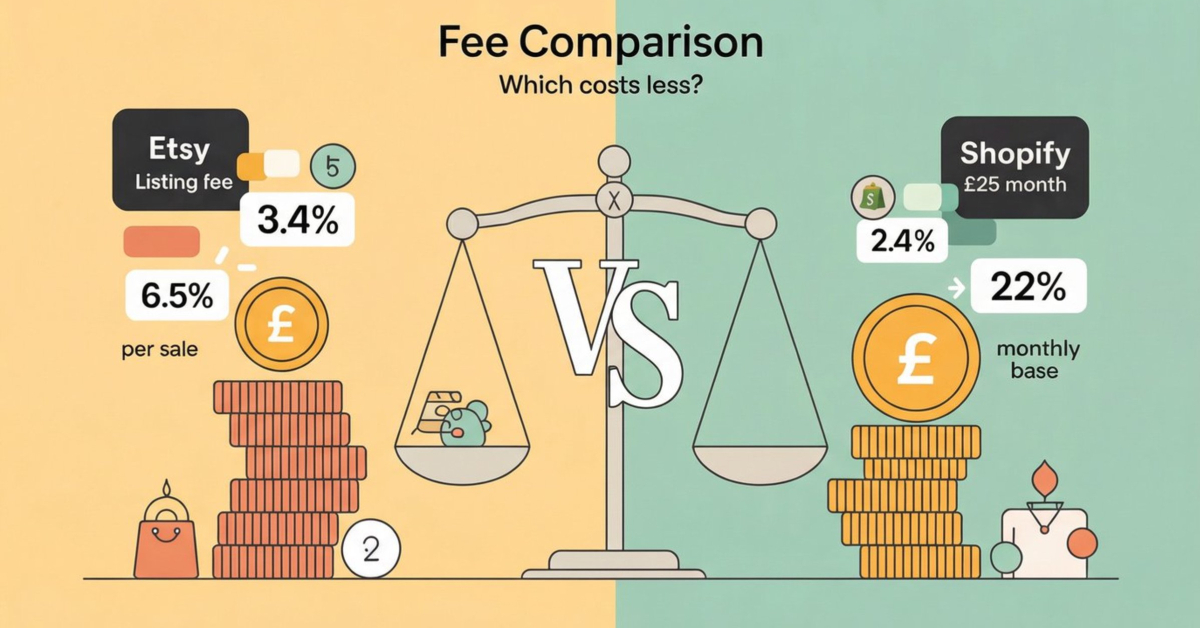
Every guide dances around this. Here are the actual costs (UK, 2025):
Etsy: You pay per sale
Fee structure:
- Listing fee: £0.16 per item (renews every 4 months or when it sells)
- Transaction fee: 6.5% of the total sale price, including shipping
- Payment processing: ~3.4% + £0.25 per transaction
- Etsy Ads (optional): 12–15% of attributed sales
Example: £25 candle sale
- Transaction fee (6.5%): £1.63
- Payment processing (3.4% + £0.25): £1.10
- Listing fee: £0.16
- Total fees: £2.89 (11.6% of sale)
- You keep: £22.11 (before materials, shipping, your time)
If you run Etsy Ads at 15%, add £3.75, bringing the total fees to £6.64 (27% of the sale price).
Shopify: You pay monthly + per sale
Fee structure:
- Shopify Basic: £25/month
- Payment processing: 2.4% + £0.25 per transaction (using Shopify Payments)
- Apps (optional): £0–£50/month for email marketing, reviews, and related services.
Example: £25 candle sale
- Payment processing: £0.85
- Monthly fee: £25 ÷ your total sales that month
At 10 sales/month:
£25 ÷ 10 = £2.50 per sale
Total per-sale cost: £3.35 (13.4%)
You keep: £21.65
At 50 sales/month:
£25 ÷ 50 = £0.50 per sale
Total per-sale cost: £1.35 (5.4%)
You keep: £23.65
Should I sell on Etsy or Shopify based on cost?
Choose Etsy if: You’re selling fewer than 30 items/month and can’t drive traffic yet. You’ll pay slightly more per sale (11–27%, depending on ads), but you won’t pay £25/month when sales are slow.
Choose Shopify if you can hit 20+ sales/month within 60 days or if you already have an audience. At 50 sales/month, Shopify costs you half what Etsy does per sale — and you’re building a customer list worth money.
The break-even point is around 20–25 sales/month, and the platforms cost roughly the same. Above that, Shopify gets cheaper per sale. Below that, Etsy is lower risk.
Should I Sell on Etsy or Shopify Based on Traffic? Here’s What Actually Works
This is where most makers fail Shopify and succeed on Etsy.
On Etsy, traffic is automatic (if you optimise)
Where sales come from:
- Etsy search (“personalised baby gift”)
- Category browsing (Home & Living → Candles)
- Etsy’s recommendation emails (“Based on your favourites…”)
Your job: Make your listings findable.
Minimum weekly effort:
- Improve 1–2 listings (better photos, clearer titles based on what’s getting favourites vs orders)
- Add 1 new listing or variation if you have capacity
- Check your Stats page → Search Terms to see what phrases bring visits, adjust titles accordingly
Example: My friend Lucy sells knitted baby clothes. She was getting visits but no sales. I looked at her data: people were finding her through “newborn hospital outfit”, but her titles said “handknitted baby set.” She changed the title and got her first sale 3 days later.
On Shopify, you must drive traffic (or you get zero sales)
Where sales come from:
- Pinterest, Instagram, TikTok (content you create)
- Google organic search (takes 6–12 months)
- Email list (once you build one)
- Paid ads (risky for beginners — easy to lose money)
Your job: Choose one traffic channel and commit to weekly consistency for at least 8 weeks.
Three proven traffic plans for handmade sellers:
Option 1: Pinterest (best for jewellery, home décor, stationery, anything visual)
- 3–5 pins per week linking directly to product pages
- Use Canva to create pins (free templates available)
- Good if you’re camera-shy — no face required
- Slower (8–12 weeks to see traction), but sustainable
Option 2: Short video (best for pottery, sewing, woodwork, process-driven products)
- 2 videos per week: film yourself making the product, show the finished piece, say who it’s for
- Post to Instagram Reels, TikTok, YouTube Shorts (same video, three platforms)
- Faster feedback (2–4 weeks to see if it’s working)
- Higher effort but higher engagement
Option 3: Email (best once you have past customers)
- 1 email per week to past buyers: new product, bestseller restock, gift guide
- Needs 100+ subscribers to feel worth it
- Best used after you have some Etsy sales to migrate customers
Target after 8 weeks of consistent effort: 100+ weekly visits to your Shopify store.
Reality check: I started with Pinterest in 2020. First 6 weeks: 12 visits/week. Weeks 7–12: 40–80 visits/week. Month 4: 150+ visits/week, first sale from a stranger. It’s slow, but it compounds.
Should I Sell on Etsy or Shopify If I Want to Stay Small?
Most guides assume you want to build an empire. Let’s be honest: many makers just want a steady side income without the overhead.
Stay on Etsy long-term if:
- You want £500–£1,500/month in side income, and you’re happy there
- You value time over revenue growth (you don’t want to learn Pinterest or email marketing)
- Your bestseller takes 3+ hours to make, and you don’t want to hire help, outsource production, or simplify it
- You enjoy making far more than marketing
There’s zero shame in this. Etsy lets you sell without building infrastructure. You list your items, fulfil orders, improve your photos, and that’s it.
But understand the trade-off: Etsy can change fees (they did in 2022), ranking algorithms (happens constantly), or policies (like adding mandatory ads in some countries) at any time. You’re renting space in someone else’s marketplace.
If that’s acceptable — and for many makers, it genuinely is — Etsy is a viable long-term choice.
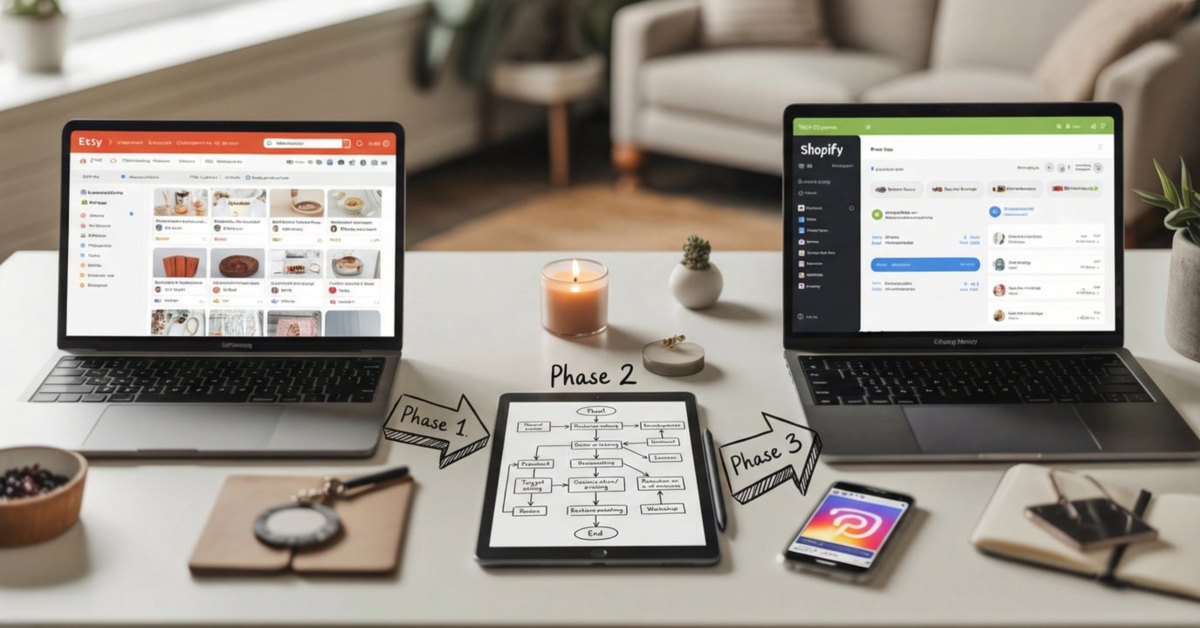
The Hybrid Strategy: Should I Sell on Etsy, Shopify, or Both?
Short answer: Eventually both, but not at the same time, from day one.
Most “use both!” advice creates two exhausting half-efforts. This phased sequence prevents that.
Phase 1: Validate on Etsy (Weeks 1–4)
Tasks:
- List your best 3–7 products (items you can make reliably and ship within your stated timeframe)
- Take proper photos (bright natural light, clean background, show scale and detail)
- Write titles using this formula: What it is + Who it’s for + Key feature
Example: “Personalised New Baby Blanket | Soft Cotton | Custom Name Gift”
How to track progress:
- Go to Shop Manager → Stats
- Watch: visits, favourites, orders
- Note which item gets the most attention
Move to Phase 2 when:
- You’re getting 10+ favourites per week on your top item
- You’ve made at least 5 sales (proves people will pay)
- You can fulfil orders reliably without scrambling
Real example: My client Emma listed 5 hand-poured candles on Etsy. Week 1: 0 sales. Week 2: 1 sale. Week 3: 3 sales. Week 4: 5 sales. Her “Vanilla & Sandalwood” candle got 24 favourites while others got 2–4. Clear winner. She moved to Phase 2.
Phase 2: Add Shopify as Your Home Base (Weeks 5–8)
Tasks:
- Sign up for Shopify, choose a simple free theme (Dawn is clean and fast)
- Build basic structure: Home, Shop/Collections, Product pages, FAQ, Contact
- Add email capture: “10% off your first order” popup using Shopify’s built-in email or Mailchimp free plan
- Choose ONE traffic channel (Pinterest or short video) and commit weekly
How to track progress:
- Shopify Dashboard → Online Store → Traffic
- MailChimp/Shopify Email → List growth
- Target: 100+ weekly visits and 5+ new email subscribers by Week 8
Move to Phase 3 when:
- You’re getting consistent weekly traffic (even if small)
- Your email list is growing (2–5 subscribers/week is fine)
- You haven’t abandoned it (showing you can sustain both)
Phase 3: Use Etsy for Discovery, Shopify for Repeats (Ongoing)
Strategy:
- Keep proven Etsy listings active (they bring in new customers)
- Launch new products on Shopify first
- Use email to convert one-time Etsy buyers into repeat Shopify customers
- Price Shopify items 10% higher (rewards direct buyers, covers email capture value)
What this looks like weekly:
- Monday: Ship Etsy orders, check stats
- Wednesday: Create 3 Pinterest pins OR film 1 short video
- Friday: Send 1 email to Shopify subscribers
- Total time: 4–6 hours/week on marketing (separate from making products)
Emma’s results after 6 months:
Etsy: 40 sales/month, mostly one-time gift buyers
Shopify: 12 sales/month, 35% are repeat customers
Email list: 340 subscribers (growing by 8–12/week)
Revenue split: 65% Etsy, 35% Shopify — but Shopify customers buy more (avg £42 vs £25 on Etsy).
Reading Your Data: Should I Sell on Etsy or Shopify Based on What’s Working?
Etsy diagnostics (What your stats are telling you)
High favourites, low orders
→ Pricing too high OR trust too low
→ Fix: Add 2–3 more photos showing detail/scale, message recent buyers asking for reviews. Test 10% price drop on new listings.
High visits, low favourites
→ Wrong audience or unclear value
→ Fix: Your keywords are attracting the wrong people. Check which search terms drive traffic (Stats → Search Terms), and revise titles to better match actual buyer intent.
Low visits
→ Search visibility problem
→ Fix: Test new keywords in titles. Use all 13 tags. Put your main keywords in the first 160 characters of your description.
Shopify monthly scorecard (With action triggers)
Profit per order < £10 (after materials, fees, time)
→ Your pricing or production cost needs work
→ Fix: Either raise prices 20–30% or simplify production. You can’t scale at £8 profit per item.
Repeat purchase rate < 15%
→ Your product lacks natural repurchase potential (most handmade items do)
→ Fix: Build gift bundles, seasonal collections, referral rewards. Don’t expect repeat sales on one-off wedding gifts — that’s normal.
Bestseller = >60% of revenue
→ You’re vulnerable to supply issues or trend shifts
→ Fix: Develop 2–3 backup strong products now while sales are good.
Time per sale is increasing
→ You’re adding complexity without raising prices (custom requests, one-off variations)
→ Fix: Create templates. Charge 30–50% more for customisation. Say no to unprofitable requests.
Common Mistakes (And Why Makers Make Them)
Starting Shopify with no traffic plan
Psychology: You’ve been told, “build it, and they will come.” Building a beautiful shop feels productive. Marketing feels uncomfortable and salesy.
Fix: Select a traffic channel before launching Shopify. Commit to weekly action for at least 8 weeks before judging results. No plan = no sales.
Creating too many weak Etsy listings
Psychology: Activity feels like progress when sales are slow. Listing new products is easier (and more fun) than improving existing ones.
Fix: Focus on 3–7 strong products. One excellent listing with great photos and refined keywords beats ten mediocre ones. Quality over quantity always.
Real numbers: I see this all the time. Maker A has 45 listings and sells 8 items/month. Maker B has 6 listings and sells 22 items/month. The difference? Maker B’s photos are incredible, and titles are keyword-optimised.
Competing on price
Psychology: When you’re not getting sales, lowering your price feels like the only lever you control.
Fix: Compete on clarity (clear photos/descriptions), craftsmanship (show the quality), gifting angle (is this a perfect Mother’s Day gift?), and trust signals (reviews, policies, about page). Raise prices on your bestsellers by 20% and watch what happens — you’ll be surprised.
No retention plan
Psychology: You’re focused on getting the first sale. Repeat customers feel like a luxury problem you’ll address “later.”
Fix: Capture emails from day one (even on Etsy, include a card in packages with a QR code to “VIP list”). A 15% repeat purchase rate vs 0% literally doubles your customer lifetime value. Simple maths: if average order is £25 and repeat rate is 15%, lifetime value is £25 + £3.75 = £28.75. If the repeat rate is 0%, the lifetime value is £25. Over 100 customers, that’s £375 extra revenue.
What to Do Next: Should I Sell on Etsy or Shopify? Your 30-Day Action Plan
If you chose: Start on Etsy
Today (30 minutes):
- Create an Etsy seller account (etsy.com/sell)
- Pick your best 3–7 products (items you can make reliably)
- Take or find your best existing photo for each
This week (3–4 hours):
- Take proper listing photos: 7 photos per product showing different angles, details, scale, and in use
- Write titles: “What it is + Who it’s for + Key feature” (60 characters max)
- Write descriptions: Put your main keywords in the first 160 characters, then tell the story
- Set realistic dispatch times (under-promise, over-deliver — better to ship early)
- Set up shipping profiles and payment
Week 2 target: First favourite or sale
Where to learn Etsy basics: Etsy Seller Handbook (free, built into your account).
If you chose: Start on Shopify
Today (1 hour):
- Sign up at shopify.com (£1 for the first 3 months as of 2025)
- Choose a clean theme (Dawn is free and fast)
- Create basic pages: Home, Shop, About, Contact, Shipping & Returns
This week (5–6 hours):
- Add your first 3–5 products with strong photos
- Write an “About” page: Who you are, why you make what you make, what makes it special
- Add email capture: Shopify Email app (free for first 10,000 emails/month) with “10% off first order” popup
- Choose one traffic plan:
- Pinterest: Create a Canva account, find “Pinterest Pin” templates, make 5 pins linking to your products
- Short video: Film yourself making one product start to finish, edit into 30–60 second clips, post to Instagram Reels, TikTok, YouTube Shorts
Week 8 target: 100+ weekly visits and 5+ email subscribers
Where to learn Shopify basics: Shopify Learn (free video courses), YouTube “Shopify tutorial for beginners 2025”
If you chose: Hybrid approach
Weeks 1–4: Etsy validation
- List 3–7 products on Etsy (follow “Start on Etsy” plan above)
- Track weekly: Which item gets the most favourites? Most orders?
- Improve that winner relentlessly: better photos, clearer title, more reviews
Weeks 5–8: Add Shopify
- Build a simple Shopify store (follow “Start on Shopify” plan above)
- Add email capture
- Start ONE weekly traffic habit (Pinterest 3–5 pins/week OR short video 2/week)
Week 8 decision point:
- If Etsy is working AND Shopify is getting visits: continue both
- If Shopify isn’t gaining traction: pause it, focus on Etsy until you have a stronger product-market fit, and you’re ready to commit to weekly traffic generation
Should I Sell on Etsy or Shopify? The Answer Is Simpler Than You Think
You’re not choosing a platform for life. You’re choosing which problem to solve first.
If you need buyers: Start on Etsy. It’s faster, lower risk, and you’ll learn what actually sells.
If you can bring traffic: Start on Shopify. You’ll own your customer relationships from day one.
If you’re unsure: Start on Etsy for 4 weeks, add Shopify once you have a proven bestseller.
The hardest part isn’t the decision. The hardest part is committing to consistent weekly action after you’ve chosen.
Pick one path. Start today. Adjust based on what you learn.
You’ve got this.
Next step: Create your Etsy shop or Start your Shopify trial — both take less than 10 minutes to set up.


