
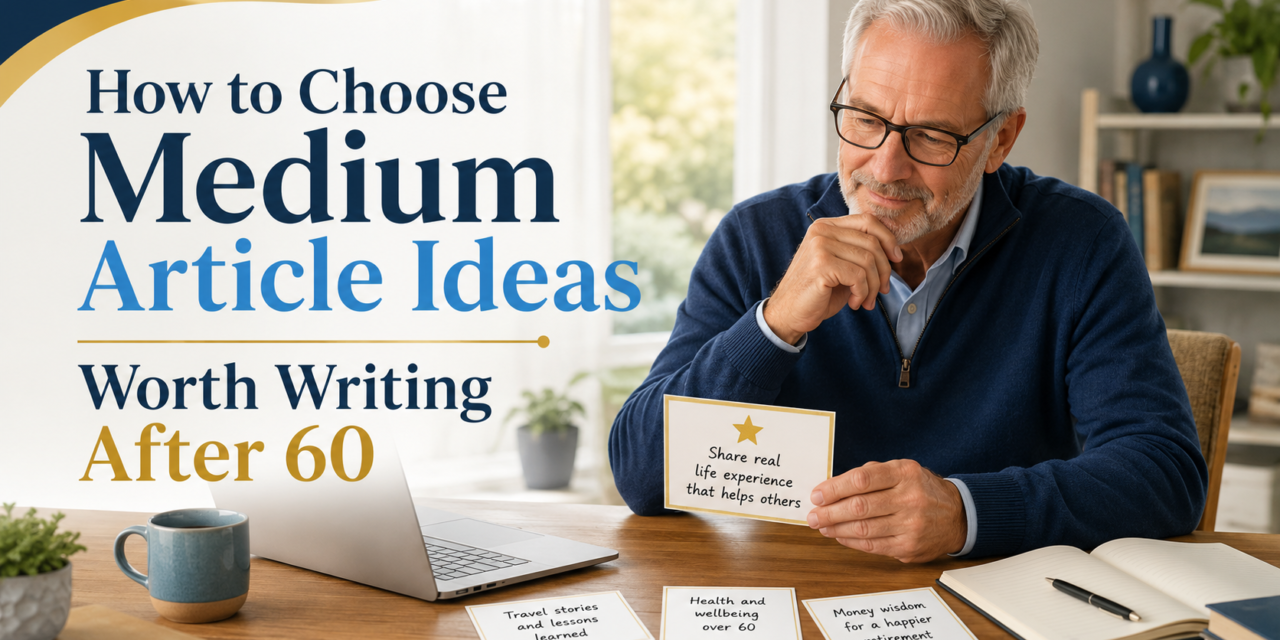
How to Choose Medium Article Ideas Worth Writing After 60
You decide you’d like to write on Medium.
You open a blank document, perhaps browse a few articles for inspiration, and then hit the first problem:
What should you actually write about?
For retirees, the problem usually isn’t a shortage of knowledge. After decades of work, family life, hobbies, decisions, mistakes and experiences, there’s often plenty to draw from.
The difficulty is knowing which of those experiences can become a Medium article someone would genuinely want to read.
Choosing a topic by instinct alone can lead to hours spent developing an article that’s too broad, too thin or dependent on research you never intended to do.
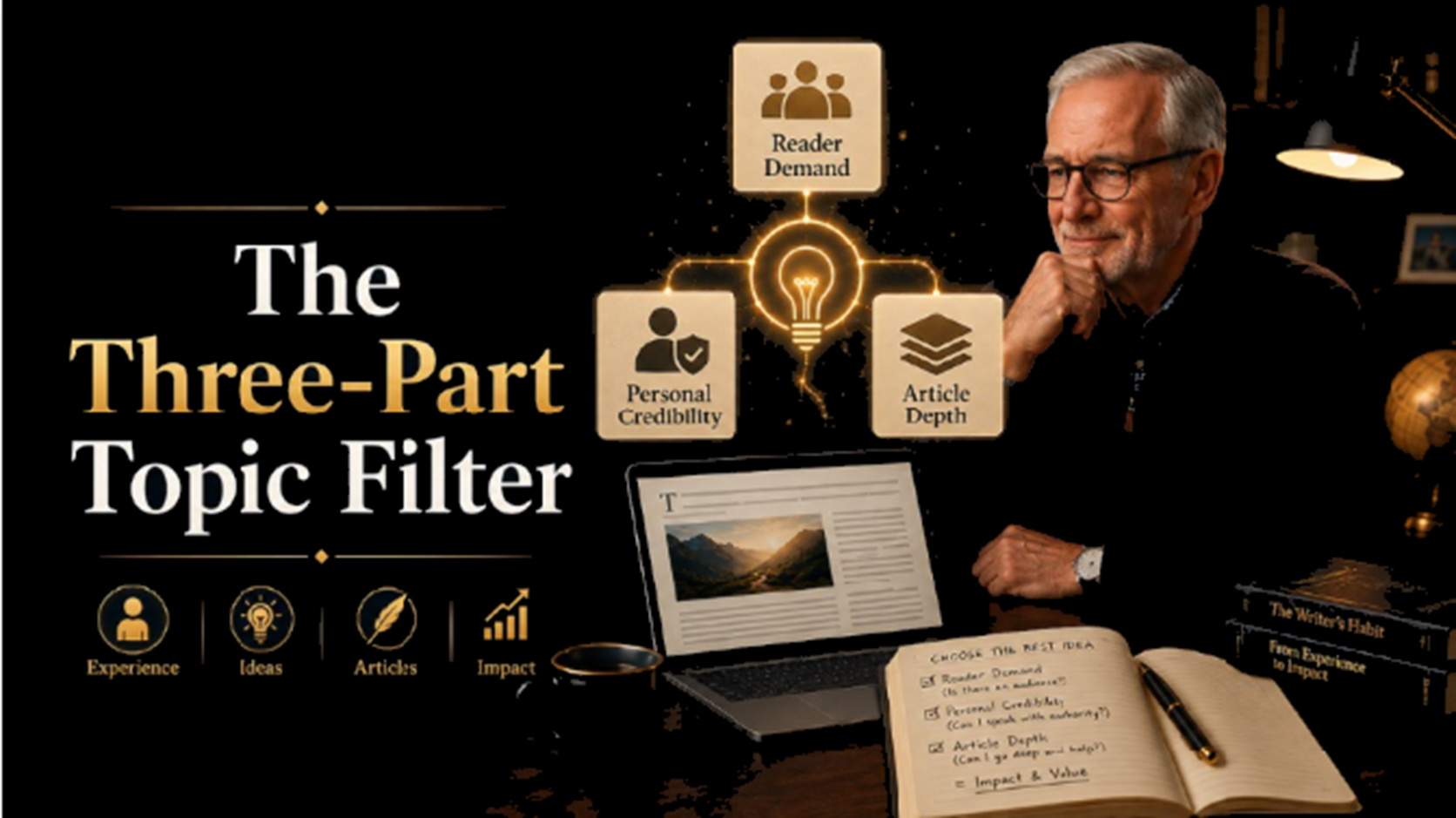
A better approach is to start with what you already know, identify a few possible topics and then test them for three things:
- Reader demand
- Personal credibility
- Article depth
That simple change can make choosing Medium article ideas much less confusing.
Why Finding Medium Article Ideas Feels Harder Than It Should
When beginners ask themselves what to write about on Medium, they often start with categories.
Retirement.
Travel.
Gardening.
Money.
Technology.
Health.
Former careers.
These might all be worthwhile subjects, but there’s an important distinction:
A subject isn’t the same as an article idea.
“Gardening” doesn’t tell you what you’re going to say.
Neither does “retirement.”
They’re starting territories, not finished ideas.
Compare:
Gardening
with:
What I Wish I’d Known Before Starting a Small Vegetable Garden After 60
The second version immediately gives you more to work with.
There’s a situation.
There’s a likely reader.
There’s experience behind it.
And there’s an obvious reason somebody considering a similar garden might want to read it.
This is one of the first things to understand when searching for Medium article ideas for retirees: don’t look only for subjects. Look for useful angles inside those subjects.
Stop Searching Everywhere for Inspiration
Browsing Medium can be useful.
It can show you how articles are presented and introduce you to subjects you hadn’t considered.
But it can also create a trap.
You see someone writing successfully about artificial intelligence, investing, entrepreneurship or another fashionable topic and think:
Perhaps I should write about that.
The problem comes when the subject has little connection with what you actually know.
You then spend most of your time researching rather than writing from genuine understanding.
The result may sound competent, but it can lack the details, judgement and examples that make an article feel grounded.
A better starting question is:
What do I already know that could become useful to somebody else?
That question is particularly powerful after retirement because experience has accumulated in places you may no longer notice.
Five Places to Look for Article Ideas You Already Have
You don’t need a list of 100 writing ideas.
Three promising candidates are more useful.
Here are five places to look.
-
Problems You’ve Already Solved
Think about something that used to frustrate you but doesn’t anymore.
Perhaps you learned how to:
- organise household paperwork
- cook efficiently for two
- plan cheaper days out
- use a new device
- sell unwanted belongings
- adjust your routine after leaving work
The interesting part isn’t simply solving the problem.
It’s what happened between confusion and competence.
What did you misunderstand?
What didn’t work?
What eventually made things easier?
Those details can become an article.
-
Things You’ve Forgotten Were Difficult
Experience has a strange side effect: once something becomes easy, you forget what it felt like when it was difficult.
Someone who books holidays online confidently may have forgotten how uncertain their first booking felt.
Someone who has been attending a walking group for years may have forgotten how uncomfortable it was to arrive alone for the first time.
This “forgotten difficulty” can be excellent article material because someone else may still be experiencing it.
-
Questions People Ask You
Pay attention when friends, family or neighbours regularly ask for your help.
“How do you organise all those photographs?”
“How do you find inexpensive hotels?”
“How did you learn to use that tablet?”
“How did you manage when you downsized?”
Repeated questions don’t guarantee a large audience, but they do reveal something valuable:
Someone else already sees useful knowledge in what you know.
-
Lessons From Your Working Life
Your previous occupation doesn’t have to become your writing niche.
Instead, ask what your job taught you that remains useful outside work.
A former manager may have lessons about difficult conversations.
A receptionist may know how to stay calm while several people need attention.
A salesperson may understand the value of listening.
A teacher may be particularly good at explaining complicated ideas simply.
The transferable lesson is often more interesting than the job title.
-
Ordinary Decisions
Don’t assume your best article must come from an extraordinary achievement.
Everyday decisions can be highly relatable.
Perhaps you’ve recently changed:
- your car
- your mobile phone
- a subscription
- where you shop
- the way you travel
- a weekly routine
- your home
A decision naturally contains useful material: what mattered, what didn’t, what surprised you and what you’d do differently.
Use the Three-Part Topic Filter
Once you’ve identified three possible article ideas, don’t immediately write the one that sounds most exciting.
Test them.
This is the distinctive approach taught inside Pensioner Publishing Payoff.
Test 1: Reader Demand
Reader demand doesn’t mean proving that thousands of people are searching for your exact article.
Ask something simpler:
Does a recognisable reader have a reason to care?
Readers might want to:
- solve a problem
- avoid a mistake
- make a decision
- understand something confusing
- gain reassurance
- satisfy curiosity
Compare:
Money in Retirement
with:
What I Stopped Paying For After Retirement
The first subject is important but vague.
The second offers a clear direction and creates curiosity.
Specificity doesn’t necessarily reduce appeal.
Very often, specificity makes the appeal easier to see.
Test 2: Personal Credibility
Next ask:
Do I have a genuine reason to write this?
Personal credibility isn’t the same as being a recognised expert.
If you’ve personally downsized, you may have useful observations about the decisions involved.
If you’ve volunteered somewhere for several years, you may have useful lessons from that experience.
If you’ve recently learned to use a particular piece of technology, you may be able to write an excellent beginner’s perspective.
The key is to match your claim to your experience.
There’s a big difference between:
What I Learned During My First Month Using AI After 60
and:
How AI Will Transform the Next Decade
The first can legitimately come from personal experience.
The second requires a much stronger level of expertise.
A useful test is whether you can quickly think of three real examples, decisions, mistakes or observations without opening a search engine.
If you can, that’s a good sign.
Test 3: Article Depth
Finally ask:
Is there enough here for a satisfying article?
A large subject isn’t automatically a deep one.
“Life After Retirement” is enormous but difficult to shape.
“What Happened When I Stopped Checking Work Email After Retirement” is far narrower yet could contain several useful ideas around identity, boundaries, routine and habit.
Before committing to a topic, see whether you can identify at least three distinct points.
If you have only one strong observation, you may write a social media post rather than a full article.
Strong, Uncertain or Weak?
You don’t need a complicated scoring formula.
Judge each of your three candidate ideas against the filter as:
Strong
Uncertain
or:
Weak
Suppose your idea is:
What I Wish I’d Known Before Downsizing My Home
Reader demand might be strong because downsizing is a recognisable decision.
Personal credibility might be strong if you’ve actually done it.
Article depth might also be strong if you can discuss storage, possessions, unexpected costs, emotional decisions, space and what you’d do differently.
That’s a promising article.
If an idea receives two weak judgements, don’t force it merely because you like the title.
Choose another candidate.
One overlooked benefit of choosing topics carefully is that discarding a weak idea before writing it is progress.
You’ve saved yourself the time required to discover the same weakness after 1,000 words.
Narrow Your Best Medium Article Idea
Even a promising topic can be too broad.
Imagine someone with decades of management experience chooses:
What I Learned Working in Management
There’s plenty to say.
Too much, in fact.
A more focused article might be:
Five Management Lessons That Made Difficult Conversations Easier
Now the writer has boundaries.
This is where people sometimes confuse narrowing with making an idea less valuable.
They’re not the same thing.
Narrowing removes material that doesn’t serve the central point.
The aim is to make the article focused without reducing it to something too small to sustain.
Look for Natural Evidence
Before starting the first draft, check for something else:
natural evidence.
Can you already remember specific situations?
Mistakes?
Surprises?
Decisions?
Comparisons?
Things you would do differently?
These details give the article substance.
Suppose you’re considering:
What I Learned After Moving From a House to a Flat
You may immediately remember furniture that didn’t fit, storage you underestimated, things you missed, what became easier and what you’d change next time.
That’s useful material.
If you repeatedly need to search online to find something to say, the topic may have moved too far from your real experience.
Research can strengthen an article.
It shouldn’t have to create your entire contribution.
How to Know You’ve Chosen a Stronger Topic
You don’t need absolute certainty before writing.
You need clarity.
You’re making progress when you can answer four questions easily:
Who is this article for?
Why would they care?
Why do I have something useful to contribute?
What distinct points will deliver the payoff?
You should also know what doesn’t belong in the article.
That’s often an overlooked sign of a strong idea.
Weak topics keep expanding.
Strong topics develop clearer boundaries.
What About Earning Money on Medium?
If earning from Medium is part of your goal, topic selection matters because attracting a click isn’t the same as holding a reader’s attention.
The Medium Partner Program allows eligible writers to earn from qualifying member engagement with eligible stories.
That doesn’t mean there’s a guaranteed relationship between choosing a particular topic and earning a particular amount.
There isn’t.
It does mean that a focused article with a recognisable reader benefit gives you a better foundation than an article chosen simply because the subject looked fashionable.
For a beginner, the practical aim isn’t to find one magical article.
It’s to develop a repeatable way of producing worthwhile ones.
Choose.
Write.
Publish.
Learn.
Then use the same decision process again.
Want the Complete Process?
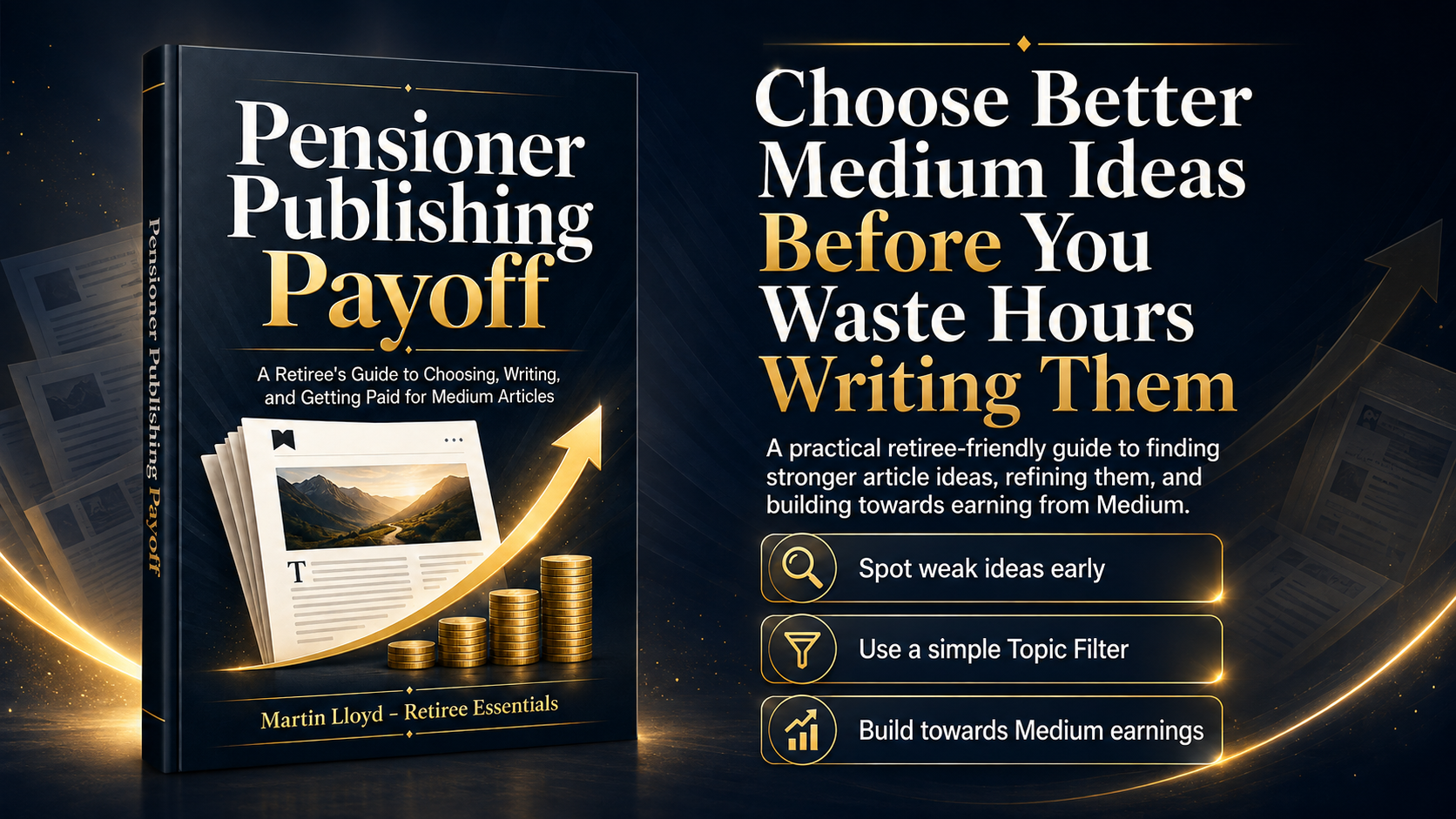
If you’re a retiree who’d like a more focused way to choose articles before investing hours in writing them, Pensioner Publishing Payoff by Martin Lloyd – Retiree Essentials takes this approach further.
The report shows you how to:
- uncover article material from experience you already have
- reduce your possibilities to three strong candidates
- apply the Three-Part Topic Filter
- identify weak ideas before they consume your time
- narrow the winning topic
- use natural evidence to strengthen it
- understand how publishing can build towards Medium Partner Program participation
It isn’t designed as a broad course on every aspect of Medium.
Its purpose is much narrower:
helping you decide what article is genuinely worth writing next.
Get Pensioner Publishing Payoff
If staring at a blank page keeps leading to the same question — “What should I write about?” — Pensioner Publishing Payoff gives you a practical way to answer it using the experience you already have.
One Good Idea Is Enough to Begin
You don’t need dozens of Medium article ideas for retirees.
You need one topic with a reader who has a reason to care, experience you can genuinely contribute and enough depth to make the article worth finishing.
Start there.
Your next article may already be hiding inside something you know so well that you’ve stopped noticing its value.