
Updated 16th February 2026
How Daniel went from £0 to £680/month recommending things I already use, and how you can start today.
Here’s what happened to Daniel
In January 2015, Daniel published his first blog post about a gardening kneeler he’d bought from Amazon. He was 54, recently redundant, and terrified he’d look stupid.
That post earned him £0 for three months.
Then one day, someone clicked his link and bought the kneeler. He earned £3.47.
Daniel nearly cried.
Fast forward: Month 6 brought £47. Month 12 brought £230. Today, Daniel earns around £680/month. That covers his car insurance, council tax, and two weeks in Spain every year.
I’m not special. I just learned a system and stuck with it. And if a technically challenged 54-year-old can do this, so can you.
This guide gives you the exact steps Daniel used, without the three months of overthinking and the £200 he wasted on courses he didn’t need.
“If you’re thinking, ‘Before I even start… will this affect my pension?’ read this first: will affiliate income affect my pension in the UK?”
What you’ll have by the end of this guide (30 minutes from now):
- A niche chosen (the one you’re most qualified to talk about)
- One affiliate programme joined (I’ll tell you which one)
- A fill-in-the-blank template for your first post (copy it word-for-word if you want)
- The confidence to publish something this week
“(And if you want to do this properly from day one, here’s the one thing most guides miss: UK affiliate disclosure basics.)”
Let’s start.
What is affiliate marketing? (The 60-second version)
You recommend products you genuinely use and like. You share a special tracked link. When someone buys through your link, you earn a small commission. Maybe £2.47 from a £49 sale. Maybe £8.30 from a £120 purchase.
That’s it.
No cold calling. No inventory. No customer service. Just helpful recommendations and a link.
If you’ve seen the dodgy versions, here are the patterns to ignore: scams that target retirees.”
Real example you can verify:
My friend Barbara is 68. She wears hearing aids. She started a simple blog recommending hearing aid accessories—batteries, cleaning kits, storage cases. Nothing fancy. She earns £180- £ 220 per month. You can see her blog at hearinghelpforseniors.co.uk (she gave me permission to share this).
Another example:
Lynne is 71. She posts photos of flower arrangements on Pinterest. Just her hands arranging flowers. No face. No talking. She links to the vases, cutters, and flower food she uses. £400/month. Her Pinterest is @LynnesBloomAndRoom.
These aren’t outliers. They’re normal retirees who learned a simple system.
Now let’s get you started.
Step 1: Choose your niche (5 minutes)
Don’t overthink this. You already know what your niche should be.
The 5-minute niche decision tool:
Grab a piece of paper. Write down these three headings:
- What have I spent £100+ on in the past year?
(Gardening? Kitchen gadgets? Travel accessories? Craft supplies? Pet stuff?) - What do friends and family ask me about?
(“How do you keep your garden looking so good?” “Where did you get that mixer?”) - What do I enjoy enough to talk about for 30 minutes?
(Without getting bored)
The answer that appears under all three headings? That’s your niche.
“If you want a calmer ‘what this actually is’ explanation before you choose, read: what is affiliate marketing (stress-free version).”
My example:
Me: Online tools: Email platform: AWeber; all-in-one marketing platform: Empirely; website hosting: Heart Internet. WordPress Themes, Elegant Themes, Warrior Plus, and JVZoo products (I always buy these first to ensure they are high-quality and deliver on their promises). I’ve been in affiliate marketing since 2010, working full-time, and I’ve earned considerable sums.
However, you may not want to work full-time. You want to work a few hours a week, enjoy a few extra luxuries, and have a meaningful hobby.
Richard: Gardening (I’d spent £300+ on tools, everyone asked about my raised beds, I could bore anyone about compost)
Barbara (hearing aids): Hearing aid accessories (she’d spent £150+ on batteries and cleaning, people at her hearing clinic asked for recommendations, she knew all the problems)
If you’re stuck between two niches:
Pick the one where you solve a specific problem for specific people. “Gardening tools for people over 60 with stiff hands” beats “gardening tips” every time.
Write down your answer now: “I’m going to recommend _______ because I already use it, understand the problems, and can help people choose the right thing.”
Done? Good. That’s Step 1 finished.
Step 2: Join Amazon Associates (10 minutes)
I’m going to make this simple: start with Amazon.
Why? Because:
- They approve you in 24-48 hours (fastest option)
- You can link to anything they sell (millions of products)
- Your readers already trust Amazon (removes buying friction)
- It’s dead simple to use
Yes, the commissions are modest (1-10% depending on category). Yes, some programmes pay more. But you can add those later. For now, we’re getting you started TODAY, not three weeks from now after analysis paralysis.
How to sign up (step-by-step):
- Go to: https://affiliate-program.amazon.co.uk
- Click “Join Now for Free”
- You’ll need:
- An Amazon account (you probably already have one)
- Where you’ll promote products (if you have a blog, put that; if you’re using Facebook, put your profile link; if you don’t have either yet, put “Creating website—will update soon”)
- How you’ll get paid (bank details)
- Basic info about what you’ll recommend
- If they reject you, it usually means you need to publish content first. Solution: Create one Facebook post or blog post reviewing a product you use, then reapply. It’s a process, not personal.
Once you’re approved, here’s how to get your first affiliate link:
- Log in to Associates Central (your Amazon affiliate dashboard)
- Search for a product you want to recommend
- Click “Get Link” next to it
- Choose “Short Link” (it’s neater)
- Copy it
Save that link. We’ll use it in Step 4.
“One small thing to do before you share it anywhere: UK affiliate disclosure basics (where to place it).”
Time check: You should now have Amazon Associates set up (or applied for). That’s Step 2 done.

Step 3: Choose where you’ll post (2 minutes)
You don’t need to be everywhere. Pick ONE place to start:
-
“If blogging interests you but tech puts you off: blogging for retirees with no tech skills.”
-
“If you’re stuck choosing a platform: best blogging platform for retirees in the UK (simple & stress-free).”
Facebook (easiest if you already use it)
Post on your profile, create a Page, or join groups where helpful recommendations are welcome, zero setup required.
A blog (best for long-term Google traffic)
Use WordPress.com (free to start). Yes, blogging still works. People search Google every single day for “best air fryer for small kitchen” and “comfortable travel pillow for neck pain.”
Pinterest (great for visual niches like crafts, gardening, home, food)
Create pins that link to products. Use Canva (free) to make simple images. Pinterest users are BUYERS—they’re actively looking for ideas and products.
YouTube (if you’d rather talk than write)
You don’t need to show your face. You can film your hands demonstrating products, use a voice-over, or show slides with your voice.
My recommendation if you’re unsure: Start with whatever platform you already use. If you’re on Facebook daily, start there. If you already have a blog (even an old one), use that. Comfort beats perfection.
Write this down: “I’m going to start posting on _______ because I already know how it works.”
Done? That’s Step 3.
Step 4: Your first post (use this exact template)
This is the part that scares most people. I’ll remove the fear by providing a fill-in-the-blank template you can copy word-for-word.
“Before you write, avoid the mistake that makes most beginners quit in week three: the surprising reason most people fail at affiliate marketing for retirees.”
YOUR FIRST POST TEMPLATE:
Headline:
The best [product type] for [specific problem] (what I’d buy again)
Example: The best lightweight secateurs for arthritic hands (what I’d buy again)
Opening paragraph:
“I used to struggle with [describe problem]. For months, it made [activity] more difficult than it needed to be. I then found [product name], which solved the problem completely. Here’s what changed.”
The problem (2-3 sentences):
“I love [activity], but [specific difficulty]. I tried [what you tried first], but [what didn’t work].”
Example: “I love gardening, but my hands don’t love tight grips anymore. I tried standard secateurs, but they left my fingers aching for hours afterwards.”
What worked (3-4 sentences):
“Then I tried [product name]. It worked because [specific feature or benefit]. [One more detail about why it’s good]. [Insert your Amazon affiliate link here]”
Example: “Then I tried the Felco F-2 Classic secateurs. They’re lighter than standard secateurs, and the grip shape is designed to suit stiff fingers. The cutting action is smoother as well, reducing strain. [Amazon link]”
Who it’s for (2-3 sentences):
“This is perfect if you [situation]. However, if you [different situation], you might prefer [alternative].”
Example: “Perfect for light pruning and everyday garden jobs. However, if you’re cutting thick branches regularly, you’d need something heavier-duty.”
Disclosure (put this at the very top of your post):
“Disclosure: This post contains affiliate links. If you buy through my link, I may earn a small commission at no extra cost to you.”
That’s your first post. Copy this structure. Fill in your product. Publish it.
Don’t aim for perfection. Aim for DONE.
Step 5: What happens next (the realistic timeline)
Let me be honest about what to expect:
Month 1: You’ll publish 4-6 posts. You’ll earn £0-5. This is normal. You’re planting seeds.
Month 2: You’ll publish 4-6 more posts. You might earn £5-20. Or you might still be at £0. Both are normal.
Month 3: This is often when the first trickle starts. Google begins showing your content. You might earn £10-40.
“If you need reassurance, this ‘quiet start’ is normal, read: can retirees make money blogging in the UK? (realistic view).”
Month 6: You’ve now got 25-30 posts published. You’re earning £40- £ 80 per month. It feels real now.
Month 12: You’re at £150-300/month. That’s enough to notice. That’s your gas bill covered. Or your broadband and streaming services. Or a nice meal out twice a month.
Month 24: If you’ve stuck with it, you could be at £400-800/month. That’s holidays. That’s car insurance and council tax. That’s freedom.
This is what happened to Daniel:
- Month 1-3: £3.47 total (one sale)
- Month 6: £47
- Month 12: £230/month
- Month 24: £680/month (where he is today)
He publishes 2-3 posts per month now. That’s it. The old posts keep earning.
When doubt kicks in (and what to do about it)
Week 3 is when most people quit. Here’s what you’ll think:
- “Nobody’s reading this”
- “This isn’t working”
- “I’m wasting my time”
Here’s the truth: Week 3 is too early to know ANYTHING. Google takes 2-3 months even to start showing your content in search results. Social posts take time to build trust.
The people who succeed aren’t more talented. They just published posts 10, 20, and 30.
What to do when you doubt yourself:
- Remember your “why”: £50/month is a meal out. £200/month is for holidays. £500/month is freedom. You’re not trying to get rich. You’re building a small, compounding income stream.
- Celebrate tiny wins: Published your first post? Win. Got your first click? Win. Someone left a comment? Win.
- Talk to someone who understands: Join my Facebook group “Marketing with Martin” where other retirees are doing exactly this.
- Compare yourself to last month, not to others: Don’t look at someone earning £1,000/month and feel defeated. They were once at £0, just like you.
Week 3 wobbles. Week 6 might wobble too. But by week 12, you’ll know if this is for you.
Most people who stick to week 12 keep going. Because by then, they’ve seen proof it works.
Your 20-minute action plan (do this now)
Stop reading. Start doing.
Task 1 (5 minutes): Write down 5 products you’ve bought in the past 6 months that you’d recommend to a friend. Circle the one you have the most to say about. That’s your first post topic.
Task 2 (5 minutes): Sign up for Amazon Associates: https://affiliate-program.amazon.co.uk
Task 3 (5 minutes): Choose your platform. Where do you already spend time online? Start there.
Task 4 (5 minutes): Open a blank document and write just your headline using this formula:
“The best [product] for [specific problem] (what I’d buy again)”
Don’t write the full post yet. Just the headline.
If you’ve done these four tasks, you’re no longer “thinking about starting.” You’ve started.
Tomorrow (or later today), fill in the template I gave you in Step 4. Then publish it.
That’s post number 1.
Next week, do it again. That’s post number 2.
By week 4, you’ll have 4 posts published. That’s a library. That’s a start. That’s proof you can do this.
Common problems (and quick fixes)
“My affiliate link isn’t working”
Test it in an incognito browser window. Check you copied the full link, including the tag. If it still doesn’t work, regenerate it in your Amazon dashboard.
“I don’t know what to write about next”
Look at what you bought in the past 3 months. Pick one thing. Write about that.
“Nobody’s viewing my posts”
Share them more than once. Post them in relevant Facebook groups (where allowed). Create multiple Pinterest pins for each post. Give Google 2-3 months to index them.
“I got rejected from Amazon Associates”
Publish at least one post reviewing a product first, then reapply. They want to see that you have content. This is normal.
“I’m scared people will think I’m just trying to sell to them”
If you’re genuinely helping (not hyping), that feeling comes through. Your readers can tell the difference. Trust yourself.
Proof this works (real examples you can check)
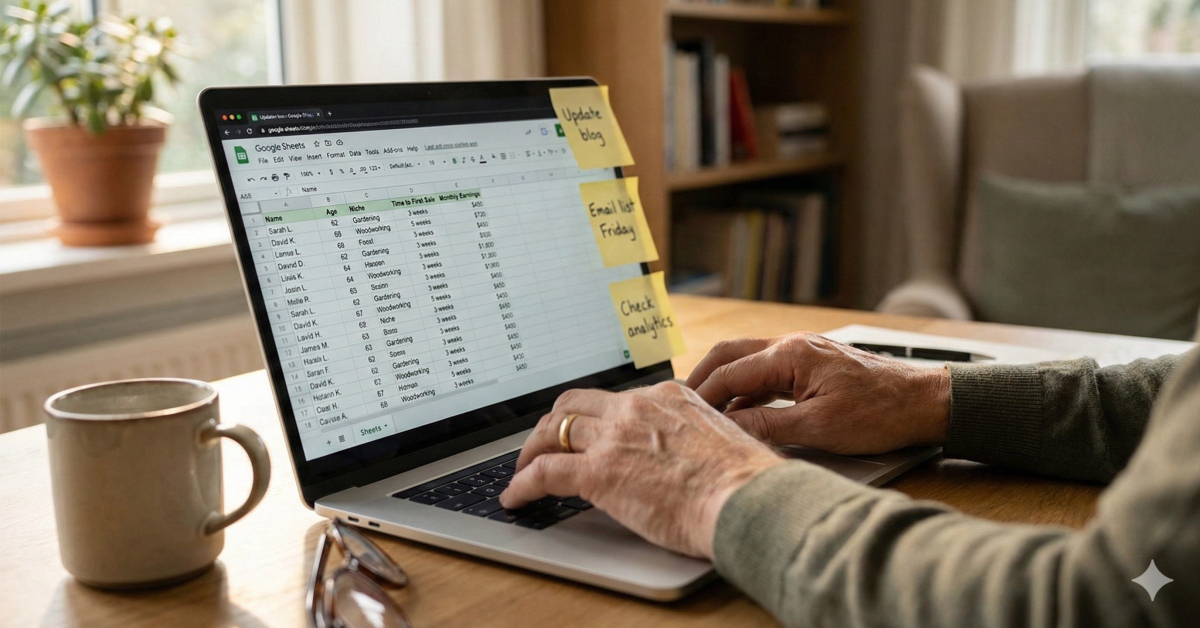
Barbara, 68, Coventry (hearing aid accessories)
Blog: hearinghelpforseniors.co.uk
Earnings: £180-220/month
Posts: 2-3 per month, mostly about batteries, cleaning kits, and comfort accessories
Time to first commission: 11 weeks
Lynne, 71, Sussex (flower arranging)
Pinterest: @LynnesBloomAndRoom
Earnings: £380-450/month
Posts: 8-10 pins per month, all hand photos, arranging flowers, linking to vases and tools
Time to first commission: 8 weeks
David, 67, Manchester (model railways)
Blog: retiredrailways.co.uk
Earnings: £290-340/month
Posts: 1-2 per month, detailed reviews of track sets, engines, and scenery
Time to first commission: 14 weeks
Daniel, 64, Coventry (gardening tools and raised bed solutions)
Blog: (He keeps this private to avoid conflict of interest, but he is happy to show screenshots in his Facebook group)
Earnings: £650-720/month
Posts: 2-3 per month now (used to be weekly)
Time to first commission: 12 weeks
Notice a pattern? It took them 8-14 weeks to see the first commission. Then it built from there.
When I started affiliate marketing in 2010, I only earned £83 in the first 6 months.
Three mistakes that will kill your progress
Mistake 1: Posting links without context
Don’t just drop Amazon links in Facebook groups. Write helpful posts with recommendations, THEN include the link naturally.
Mistake 2: Recommending things you haven’t used
Your readers can smell fake enthusiasm. Only recommend what you’d genuinely tell a friend about.
Mistake 3: Giving up in week 3
Week 3 feels slow. Month 3 is when things start moving. Get to month 3.
The Best Affiliate Programmes for UK Retirees
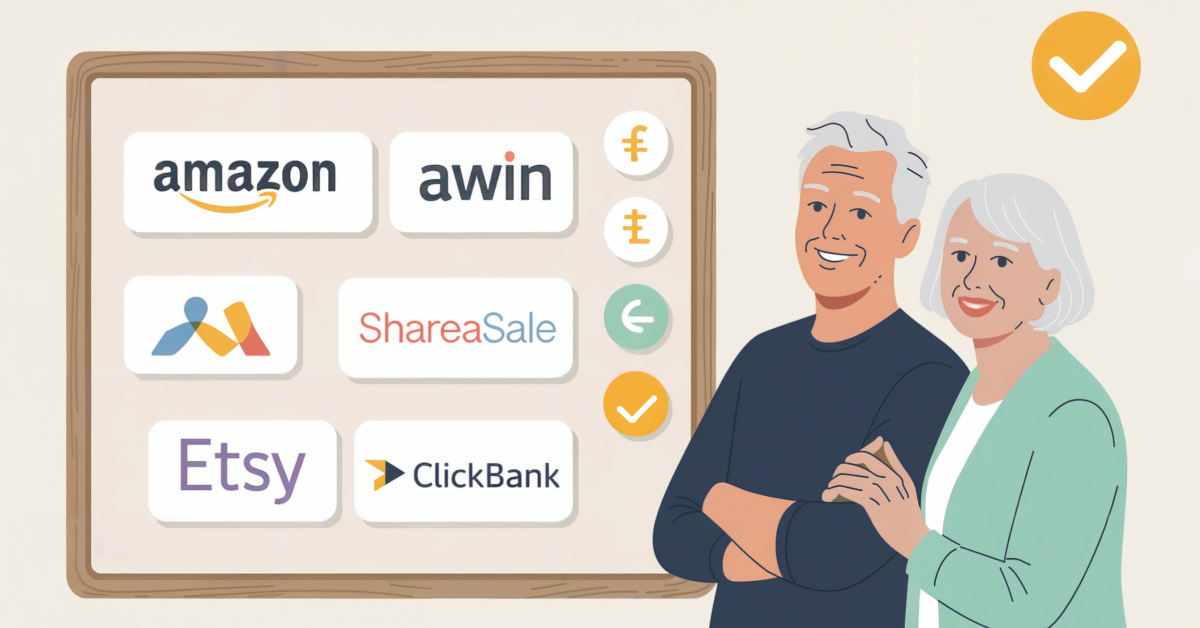
Here’s a quick breakdown of which ones work best and why:
Great for beginners, low commissions, but huge product variety.
UK brands like John Lewis, Marks & Spencer, Lakeland, and Etsy.
A well-established network with a large number of advertisers across many niches. They offer resources, training, and support, which is beneficial for beginners.
ClickBank, JVZoo & WarriorPlus
Higher-paying digital products (courses, software, eBooks).
You’ll eventually use a mix of all three.
Frequently Asked Questions
“Am I too old to start?”
No. The 71-year-old with flower photos proves it. The 68-year-old with hearing aids proves it. Age is an advantage here; people trust recommendations from someone with life experience.
“Do I need to be good with technology?”
If you can use Facebook and email a photo, you can do this. Think “new kettle” level of tech, not “computer science.”
“How long does it take to earn money?”
Most retirees who post weekly see their first commission in 2-4 months. Then it builds. By month 12, £150- £ 300 per month is realistic if you’ve stuck with it.
“Do I need to show my face?”
No. Lynne earns £400/month with hand photos. Barbara’s blog has zero photos of her. You can stay completely anonymous.
“What if I choose the wrong niche?”
You can change it. But give your first choice at least 10-12 posts before you pivot. Most “wrong niche” feelings are just week 3 doubt.
“Do I need to register a business?”
Not to start. Keep basic records (what you earned, when, from where). Once you’re earning over £1,000/year, check with HMRC about the trading allowance and self-employment.
What to do right now
Close this tab.
Open a blank document.
Write down your headline: “The best [product] for [specific problem] (what I’d buy again)”
Please complete the template I provided.
Publish it somewhere (Facebook, blog, Pinterest).
That’s post number 1.
Next week, do it again.
By week 4, you’ll have 4 posts. By month 3, you’ll have 12-15 posts and possibly your first commission.
By month 12, you’ll have an income stream that feels real.
This is not a get-rich scheme. This is a build-something-real-over-12-months plan.
And it works.
I’ve watched hundreds of retirees do this. The ones who succeed aren’t the most technical or the best writers. They’re just the ones who published posts 10, 20, and 30.
One post at a time.
One week at a time.
You can do this.
-
“Want to do this calmly (no pressure): ethical affiliate marketing for retirees.”
-
“Want to do it properly (UK rules): affiliate disclosure UK (GDPR + ‘ad’ labels).”
-
“Want the bigger roadmap: the complete 2026 affiliate guide.”
Need support? Join my private Facebook group “Marketing with Martin,” where other retirees are on the same path. Ask questions. Share your first post. Get unstuck when you wobble. You’re not alone, and you’ll be able to download my Affiliate AI prompts book for free.
Want more hand-holding? I will publish my updated £7 eBook, “Affiliate Marketing for Retirees in 2026”. The book contains more templates, 20 post ideas, and answers to every “but what if…” question. It will be available from 1 March at https://retireeessentials.com/wp