

If you’re over 60 and wondering whether you have enough money for retirement, the latest headline figure may be alarming.
According to Pensions UK’s 2026 Retirement Living Standards, a single person outside London needs around £45,400 a year after tax for what it calls a Comfortable retirement.
But £45,400 isn’t the number I’d concentrate on.
I’d work out this one:
What you want to spend
− dependable income you already expect
= your personal retirement gap
That gap might still require some thought and planning.
But it’s a far more useful number than £45,400 because it is your number.
And you can start working it out today.
What does £45,400 actually mean?
Pensions UK’s Retirement Living Standards give three annual benchmarks for a one-person household:
- Minimum: £13,900
- Moderate: £32,700
- Comfortable: £45,400
These are not pass-or-fail retirement targets.
They illustrate what different lifestyles might cost.
The Comfortable level includes considerably more freedom for holidays, eating out, leisure, replacing a car and other discretionary spending.
And there’s an important detail that can easily be missed:
rent and mortgage costs aren’t included in the headline figures.
So somebody who owns their home outright could have a very different requirement from somebody paying £900 a month in rent.
That’s why asking:
“Do I have enough for a £45,400 retirement?”
isn’t particularly useful.
A better question is:
“What will my retirement cost, and how much of that is already covered?”
Step 1: Find your Lifestyle Number
Start with what you actually spend.
You don’t need a complicated spreadsheet.
Look at your bank statements and estimate a normal month.
Include things such as:
- housing costs;
- council tax and utilities;
- food;
- transport;
- insurance;
- phone and broadband;
- holidays;
- hobbies and days out;
- meals and socialising;
- gifts and family spending;
- home maintenance;
- a sensible allowance for unexpected costs.
Let’s say your total comes to £2,250 a month.
That’s £27,000 a year.
It doesn’t matter that Pensions UK’s Comfortable benchmark is £45,400.
For the moment, £27,000 is the number that matters to you.
Call it your Lifestyle Number.
Step 2: Find your Dependable-Income Number
Next, work out how much of that lifestyle is already covered.
Start with your State Pension.
For 2026/27, the full new State Pension is £241.30 a week, or £12,547.60 a year.
But don’t assume you’ll automatically receive the full amount.
GOV.UK makes clear that your actual State Pension depends on your National Insurance record.
So check your personal State Pension forecast.
Then gather the latest statements for any:
- workplace pensions;
- final salary or defined benefit pensions;
- private pensions;
- annuities or other guaranteed retirement income.
If you’ve had several employers and think you’ve lost track of a pension, trace it before assuming it doesn’t exist.
You’re trying to answer one question:
How much dependable income will I receive every month?
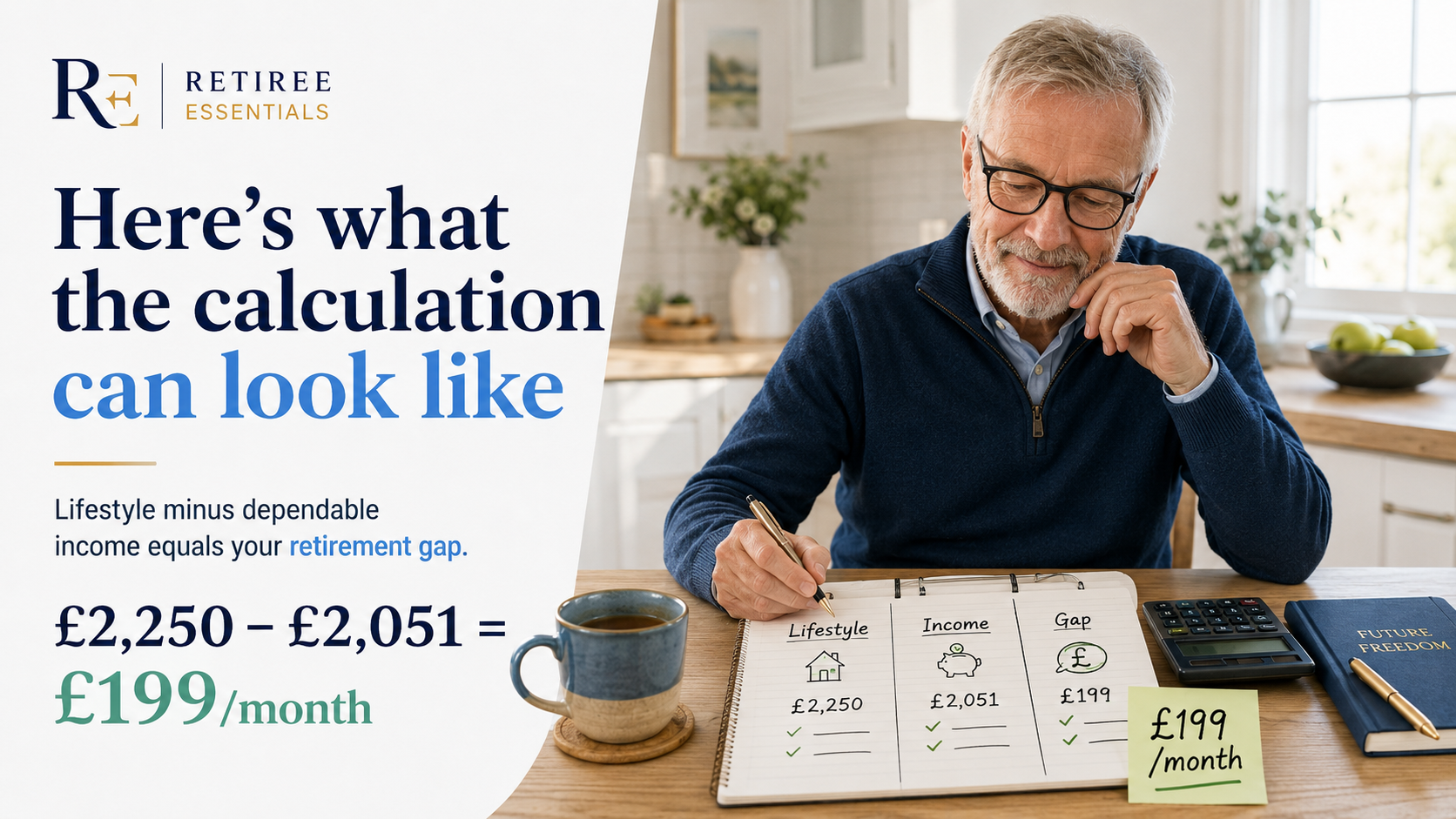
Here’s what the calculation can look like
Imagine a 66-year-old retiree called David.
This is an illustrative example, not a real individual, but the numbers show how the calculation works.
David estimates that the retirement lifestyle he wants costs:
£2,250 a month
He expects approximately:
- £1,046 a month equivalent from the full new State Pension;
- £720 a month from two workplace pensions;
- £285 a month from a small defined benefit pension.
Total dependable income:
£2,051 a month
Her calculation is therefore:
£2,250 lifestyle
− £2,051 dependable income
= £199 monthly gap
That is a very different problem from:
“I need £45,400 a year.”
David doesn’t need to find £45,400.
He needs to decide what, if anything, she wants to do about approximately £199 a month.
That is his Retirement Gap Number.
Your number might be £50.
It might be £500.
You may discover you don’t have a gap at all.
The important thing is to stop worrying about somebody else’s number before you’ve calculated your own.
Why the headline figure can be misleading
Interestingly, Pensions UK itself warns against treating these figures as personalised targets.
Its 2026 calculations suggest that a single person aiming for the Comfortable standard might need £54,720 before tax and potentially a substantial private pension pot after allowing for the full State Pension.
But Pensions UK explicitly describes those calculations as indicative, not personalised.
That’s the crucial distinction.
Retirement circumstances vary enormously.
Two people of exactly the same age could have completely different financial needs.
One owns a mortgage-free bungalow, rarely travels and spends most of their spare time gardening.
Another rents, runs a car, takes several holidays and regularly helps children or grandchildren financially.
Why would they need the same retirement income?
They wouldn’t.
What if you’re still working?
If you’re over 60 but haven’t retired yet, your gap gives you something specific to investigate.
Instead of thinking:
“I haven’t saved enough.”
you can ask:
“What could reduce this particular gap?”
One possibility is your workplace pension.
Check:
- what you’re contributing;
- what your employer contributes;
- whether your employer will contribute more if you increase your contribution;
- what your current pot is worth;
- what income your provider projects.
You may still have time to improve the position.
But the aim isn’t to compensate for everything you didn’t do at 30.
It’s to make the most sensible decisions available from where you are now.
What if you’re already retired?
The same calculation still works.
Suppose your gap is £150 a month.
You now have a specific problem to examine.
Could £50 disappear by reviewing unused subscriptions, insurance renewals or other regular spending?
Would earning £100 a month occasionally be realistic and enjoyable?
Could part-time work, freelancing, tutoring, consulting or a small online activity suit your experience and circumstances?
Or would you rather reduce discretionary spending?
None of those answers is automatically right.
The benefit is that you now have a £150 problem rather than a £45,400 fear.
That makes decisions easier to evaluate.

Don’t rush to combine old pensions
If you discover several old pension pots, don’t automatically move them all into one account.
Tidying everything up can sound sensible.
But an older pension may contain valuable guarantees, protected benefits or favourable terms that you could lose by transferring it.
So use this order:
Trace it.
Understand it.
Then decide whether doing anything with it makes sense.
If you’re uncertain, seek appropriate guidance or regulated financial advice before transferring valuable pension benefits.
Your 30-minute Retirement Gap Check
You can start this today.
Take a sheet of paper and divide it into three sections.
- My Lifestyle Number
Write down approximately what you expect to spend each month in retirement.
£________ per month
- My Dependable-Income Number
Add together your expected monthly income from your State Pension and other dependable pension income.
£________ per month
- My Retirement Gap
Now subtract:
Lifestyle Number − Dependable Income = Retirement Gap
£________ per month
That’s the number to investigate.
Not £45,400.
Not your neighbour’s pension.
Not the pension pot somebody on YouTube says everyone needs.
Your gap.
Four things to do next
If you don’t yet know your three numbers, do these in order:
- Check your State Pension forecast.
Use the official GOV.UK service rather than assuming you’ll receive the maximum. - Find your pension statements.
Gather paperwork or online statements from previous and current pension providers. - Trace anything that’s missing.
If you remember paying into a workplace pension but can’t find the details, use the government’s Pension Tracing Service to locate the scheme. - Calculate your monthly retirement gap.
Compare your expected income with the lifestyle you actually want.
If you’re aged 50 or over and have a UK defined contribution pension, Pension Wise, provided through MoneyHelper, offers free and impartial guidance on the ways you can take your pension.
For decisions requiring a recommendation about what you personally should do, consider speaking to a regulated financial adviser.
Stop asking whether you’ve reached somebody else’s number
The £45,400 Comfortable Retirement Living Standard is useful.
It gives us a picture of what a relatively generous retirement lifestyle might cost.
But it cannot tell you whether you’re ready for retirement.
Your answer depends on your home, your spending, your pensions, your plans and the life you actually want.
So rather than worrying about one enormous national figure, find three smaller ones:
What will my retirement lifestyle cost?
How much dependable income will I already have?
What’s the gap between the two?
Give yourself 30 minutes and find those numbers.
Because once you know your Retirement Gap Number, you have something far more useful than another frightening retirement headline.
You have a number you can actually work on.
This article provides general information, not personalised financial advice. Pension benefits, tax treatment and individual circumstances vary. Check information relating to your own pensions and consider regulated financial advice before making significant pension or investment decisions.